
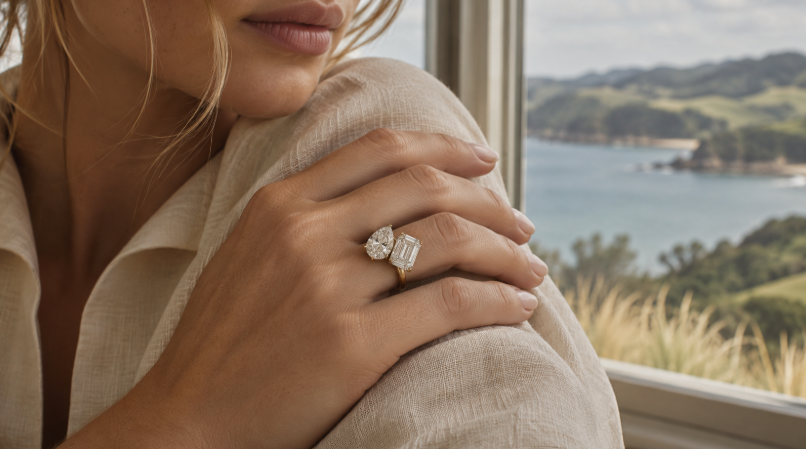
A two-stone engagement ring leaves room for contrast. A rounded diamond might sit beside an angular emerald cut, or a pear-shaped stone might lean towards an oval. Known as the toi et moi ring, from the French expression for ‘you and me’, the design gives each stone its own identity while bringing them together in a single setting.
For couples in New Zealand considering laboratory-grown diamonds, this style opens up interesting choices around proportions, stone quality and everyday comfort. The challenge is finding two diamonds that look right together without compromising the way the ring fits or wears.
Two diamonds, one balanced design
A successful pairing does not necessarily require stones of equal size. An elongated pear can look larger than a round diamond of similar carat weight because weight measures mass rather than visible surface area. Looking at measurements in millimetres gives a better indication of how much space each stone will occupy on the finger.
A search for lab grown diamonds NZ is one starting point for comparing local jewellery options, including those from Novita Diamonds. Rather than selecting stones from separate photographs, ask to see them together under the same lighting. Differences in colour or visual brightness may become noticeable when diamonds sit side by side.
An oval and a pear create a softer, flowing outline, while a round brilliant paired with an emerald cut provides a stronger geometric contrast. Neither arrangement is inherently better; the choice depends on the appearance the wearer prefers.
Reading diamond reports in 2026
Laboratory-grown diamonds are made using controlled processes that reproduce diamond crystal growth. The two principal methods are high-pressure, high-temperature (HPHT) and chemical vapour deposition (CVD). These stones are diamonds, unlike alternatives such as cubic zirconia, which has a different chemical composition.
The familiar four Cs of diamond selection are cut, colour, clarity and carat weight. However, the Gemological Institute of America (GIA) introduced a revised assessment service for colourless to near-colourless laboratory-grown diamonds on 1 October 2025, using the overall descriptions Premium and Standard.
That change makes it worth checking which laboratory issued a stone’s report and when. If the diamonds have separate documents, compare their measurements and available quality details rather than assuming different reporting formats are directly interchangeable. Ask the jeweller to explain any unfamiliar terms.
A setting that suits ordinary days
The romantic symbolism of a toi et moi design works particularly well with lab made diamonds, since contrasting shapes can represent two distinct personalities. Yet the practical side of the ring deserves equal attention. A pear or marquise diamond has a pointed end that needs protection against accidental knocks.
Consider how often the wearer uses gloves, works with their hands or participates in outdoor activities. Someone who regularly gardens or spends weekends tramping may appreciate a lower-profile design, although rings are best removed during activities that could damage them.
The wedding band also deserves an early fitting. A two-stone arrangement can extend beyond the engagement ring’s band, leaving a gap beside a straight wedding ring. A curved or contoured band may fit more comfortably if the stones sit close to the finger.
Where the jewellery budget goes
When comparing quotes from Novita Diamonds or another jeweller, request the total in New Zealand dollars and check whether GST is included. Ask which costs cover the diamonds, precious metal, setting and any custom work. Two rings with similar combined carat weights may still differ substantially in construction and appearance.
Confirm what is included in aftercare, especially resizing and inspections of the stone settings. An unusually shaped ring may require specialised work, so knowing the retailer’s arrangements beforehand can prevent unexpected expenses later.
Environmental claims deserve the same scrutiny as pricing. Laboratory production does not establish a diamond’s overall environmental impact on its own. Ask for evidence behind specific claims about electricity sources, emissions or manufacturing practices rather than relying on broad descriptions of sustainability.
Buying with confidence in New Zealand
The Consumer Guarantees Act provides protections when people purchase goods for personal use from businesses trading in New Zealand. If jewellery fails to meet applicable guarantees, a repair, replacement or refund may be available, depending on the circumstances. These protections are distinct from a shop’s voluntary change-of-mind policy.
Before ordering a custom ring, confirm the expected completion date, deposit terms and what happens if the finished piece differs from the agreed design. Keep copies of the quotation, diamond reports and written correspondence.
A thoughtfully designed two-stone ring should look appealing from several angles, sit comfortably on the hand and work alongside other jewellery. Giving those details the same attention as the diamonds themselves makes it easier to choose a piece that feels natural to wear long after the proposal.